
Last updated: July 2026
Retirement planning is one of the most confusing parts of a government career in Pakistan — and 2026 has brought more changes than usual. Between the Revised Basic Pay Scales 2026 (RBPS-2026), a fresh 7% pension increase, a new contributory pension scheme for future employees, and revised family pension rules in Punjab, pensioners and soon-to-retire employees have a lot to track.
This guide brings together everything in one place: how pension is calculated, the 2026 pension formula, family pension rules, early retirement pension, the full pension increase history, and how to work out your pension arrears. If you’re preparing for retirement or checking your numbers as a serving employee, use our Pension Calculator Pakistan 2026-27 alongside this guide, our GP Fund & Retirement Benefits Calculator, and browse current government jobs in Pakistan if you’re planning your next career move before or after retirement.
Table of Contents
How Pension Is Calculated in Pakistan
Pension for federal and provincial government employees in Pakistan is calculated under the Civil Service Pension Scheme, a non-contributory, defined-benefit system that has applied to civil servants for decades. Under this scheme, employees become eligible for a full pension after 25 years of service or upon reaching age 60, whichever comes first, and the benefit is paid from the government’s current budget rather than a separate pension fund.
Three factors determine your final pension amount:
- Total emoluments – your last basic pay plus pensionable allowances such as Special Pay, Personal Pay, and Qualification Pay
- Qualifying service – total years of service counted toward pension, capped at 30 years for the standard 70% replacement rate, with a hard ceiling of 35 years for additional increments
- The retiring year increment – an extra annual increment added if you retire between July and November; employees retiring between January–May or in December do not receive it
Once these figures are known, the Accountant General Pakistan Revenue (AGPR) applies the standard government formula to arrive at your gross monthly pension, before commutation and any applicable ad hoc increases are added.
Pension Formula 2026
The official government pension formula, used by AGPR and provincial accounts offices alike, is:
Gross Pension = (Total Emoluments × Qualifying Service × 7) ÷ 300
Worked example: An employee retiring with total emoluments of Rs 150,000 and 30 years of qualifying service would calculate: (150,000 × 30 × 7) ÷ 300 = Rs 105,000 gross monthly pension
From this gross figure, employees typically commute a portion (commonly up to 35%) into a lump sum at retirement, with the remainder paid monthly and restored to the full amount after the commutation period (usually 12 years, though older pensioners fall under a 15-year rule). The 2026 pension formula carries one important structural change: the RBPS-2026 pay revision permanently merged the 2022 and 2025 ad hoc relief allowances into basic pay, which raises the pensionable base for anyone retiring from 2027 onward. Employees retiring before this merger took effect calculate their pension on the older, lower basic pay structure — a gap that has real long-term impact on lifetime pension income.
If crunching these numbers manually feels overwhelming, our Pension & Commutation Calculator automates the entire formula, including the retiring year increment and current-year increases. For the official grade-wise revised basic pay behind this formula, see the Federal Salary Increase Calculator & BPS Pay Chart 2026-27 on New Pakistan Jobs.
Pension Rules Pakistan 2026 — What Changed
Several major reforms are now in effect or newly announced:
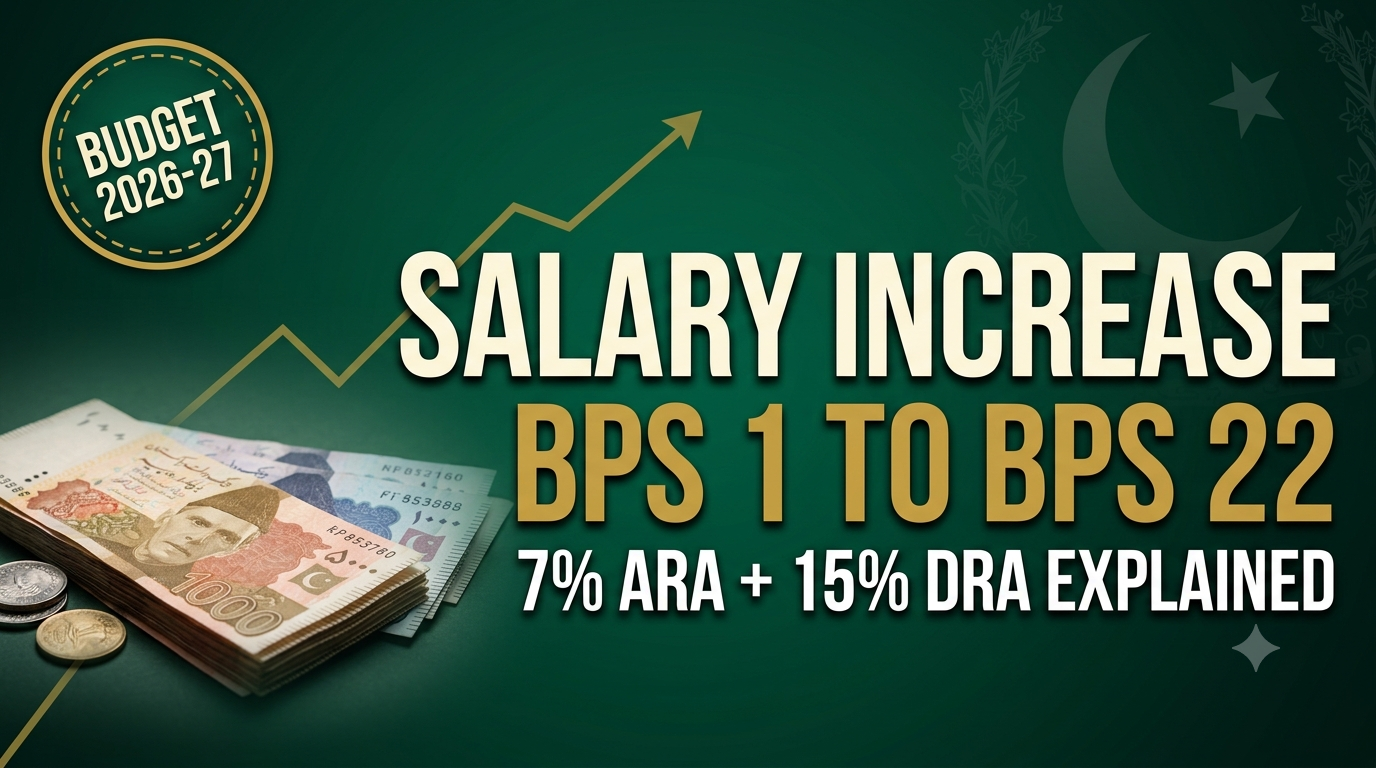
- 7% pension increase (Budget 2026-27): The federal cabinet, chaired by Prime Minister Shehbaz Sharif, approved a 7% increase in pensions alongside salaries as part of the Budget 2026-27 proposals (The Nation, June 12, 2026). Finance Minister Muhammad Aurangzeb confirmed the figure is effective from the July 2026 pension payment, matching the rate granted in Budget 2025-26. For example, a retiree drawing Rs 35,000 per month gains roughly Rs 2,450, reaching about Rs 37,450, while a retiree on Rs 80,000 gains around Rs 5,600, reaching about Rs 85,600.
- Provincial divergence: Punjab set its own pension increase at only 3.5% in its 2026-27 budget — half the federal rate — while its salary increase matched the federal 7%, a notable break from previous years when the two figures moved together.
- New contributory pension scheme for new entrants: Under the Federal Government Defined Contribution (FGDC) Pension Fund Scheme Rules 2024, new federal employees now fall under a defined-contribution model instead of the traditional defined-benefit scheme, with employees contributing 10% of pensionable pay and government contributing 12% (Dawn, October 4, 2025). This does not apply to existing employees, whose entitlements remain protected under the old rules.
- RBPS-2026 basic pay merger: As above, this restructures the pensionable base for anyone retiring after the changeover, generally improving the calculation base for future retirees compared to those who retired just before it.
Government employees currently serving should also review our Federal Salary Increase Calculator & Pay Scale 2026-27 to understand how the RBPS-2026 merger affects their pensionable salary long before retirement.
Family Pension Rules
Family pension is the monthly benefit paid to eligible dependents after a government employee or pensioner passes away, whether death occurs during service or after retirement.
Key eligibility rules currently in force:
- The pension is first payable to the widow or widower, and thereafter to eligible minor children.
- Where a pensioner leaves more than one widow, the pension is divided equally among them.
- Family pension for eligible children generally continues up to age 21 under a Finance Division office memorandum that took effect on September 10, 2024, after which the benefit stops once the child reaches adulthood (The Express Tribune, January 27, 2025).
- Punjab’s July 2026 policy shift: The Punjab government, under Chief Minister Maryam Nawaz, restored lifetime family pension for widows and unmarried daughters of deceased government employees, reversing the earlier rule that had capped these payments at 10 years (Daily Pakistan, July 11, 2026). A widow’s pension still ceases upon remarriage, and where more than one widow survives, the amount is split equally among them.
- Divorced or widowed daughters may also qualify for family pension under specific documentary conditions (Nikahnama, divorce certificate, or husband’s death certificate, depending on the case).
Because family pension rules now differ between federal and provincial governments — and Punjab’s rules changed again in mid-2026 — dependents should confirm the current policy with their relevant Accountant General office before submitting a claim. For related retirement and service-record guidance, browse our Government Employee’s Info section.
Early Retirement Pension
Government employees in Pakistan can opt for voluntary retirement before reaching the standard retirement age of 60, but doing so affects the final pension calculation:
- Voluntary or premature retirement generally requires a minimum of 25 years of qualifying service to draw a full pension; retiring with fewer years typically means a reduced pension or, in some cadres, only gratuity.
- Employees who retire early through voluntary retirement or for departmental reasons may see reduced qualifying service, which lowers both the gross pension and the commutation amount compared to full-term retirement.
- The retiring year increment rule still applies based on the month of retirement (July–November retirees receive it; other months do not).
- Certain categories — armed forces personnel, judges, and contractual employees — follow separate retirement age and pension rules under their own service regulations, rather than the general civil service framework.
Employees weighing early retirement should run the numbers both ways — full-term versus early exit — before deciding, since the difference in lifetime pension income can be significant. Our GP Fund & Retirement Benefits Calculator 2026 can help estimate both scenarios, including your GP Fund balance alongside your pension.
Pension Increase History Pakistan
Pakistan’s government has granted an annual (or near-annual) ad hoc pension increase for years, layered on top of the base pension. Recent increases include:
| Budget Year | Pension Increase | Notes |
|---|---|---|
| 2022-23 | 15% (merged into basic pay in 2026) | Ad hoc relief allowance, later absorbed into RBPS-2026 |
| 2024-25 | Ad hoc increase (Finance Division circular) | Applied to federal pensioners |
| 2025-26 | 7% | Matches 2026-27 rate |
| 2025 (Ad hoc, mid-year) | 10% | Merged into basic pay in 2026 |
| 2026-27 (Federal) | 7% | Effective from July 2026 pension payment |
| 2026-27 (Punjab) | 3.5% | Half the federal rate — first divergence in years |
Beyond annual increases, pensioners also receive an additional pension/family pension on turning 65, and periodic medical allowance increases have been layered in separately from the base pension increase. Official notifications for each year’s increase are issued by the Finance Division, Government of Pakistan and implemented by AGPR and provincial accounts offices. Because federal pension expenditure has grown sharply — from roughly Rs 821 billion in 2023-24 to about Rs 1.055 trillion in 2024-25 (Dawn, October 4, 2025) — the government has been under IMF-linked fiscal pressure to moderate future increases, which is a likely reason behind Punjab’s lower 3.5% rate this year compared to the federal 7%.
For your revised take-home figure after this year’s increase, use our Pension Calculator Pakistan 2026-27, which is updated for the current rate.
Pension Arrears Calculator Guide
Pension arrears arise when a retiree is owed back-payment — for example, when an annual increase, the RBPS-2026 revision, or a delayed pension case is applied retroactively. To calculate arrears accurately:
- Identify the effective date of the increase or correction (e.g., July 1, 2026 for the federal 7% increase).
- Calculate the difference between your old monthly pension and the new, corrected monthly pension.
- Multiply the difference by the number of months between the effective date and the date the arrears are actually processed and paid — note that AGPR and some provincial accounts offices may process adjustments in August rather than July depending on departmental cycles.
- Add any restored commutation amount separately if your case also involves a pension restoration (“double date”) milestone, since restoration and ad hoc increases are calculated independently.
- Cross-check against your pension book (PPO) and your bank pension slip, since manual processing errors — such as an omitted retiring year increment — are a common cause of arrears disputes.
If your pension case involves multiple overlapping changes (e.g., a 2025 ad hoc increase, the 2026-27 increase, and a commutation restoration date, all in the same year), it’s worth requesting an itemized breakdown from your Accounts Officer rather than relying on a single lump-sum arrears figure. Use our Pension Calculator Pakistan 2026-27 alongside your old pension slip to work out the monthly difference, then multiply it out for your arrears period.
FAQs
What is the current pension increase in Pakistan for 2026-27? Federal government pensioners received a 7% increase in net pension effective from the July 2026 payment. Punjab pensioners received a lower 3.5% increase under the provincial budget.
What is the pension formula used in Pakistan? Gross Pension = (Total Emoluments × Qualifying Service × 7) ÷ 300, with qualifying service capped at 30 years for the standard rate.
How long does family pension continue after a government employee’s death? It depends on the province and category. Federally, eligible children generally receive family pension up to age 21. In Punjab, widows and unmarried daughters are now entitled to lifetime family pension as of July 2026, reversing the earlier 10-year limit.
Can I retire early and still get a pension? Yes, provided you have completed the minimum qualifying service (generally 25 years). Early retirement can still reduce your final pension amount compared to retiring at full service length.
Where can I verify my official pension figures? Through your relevant Accountant General office or the AGPR pension calculator portal; our tools are for reference and planning only.

1 thought on “Pension Rules Pakistan 2026: Complete Guide to Calculation, Family Pension, Early Retirement & Increases”