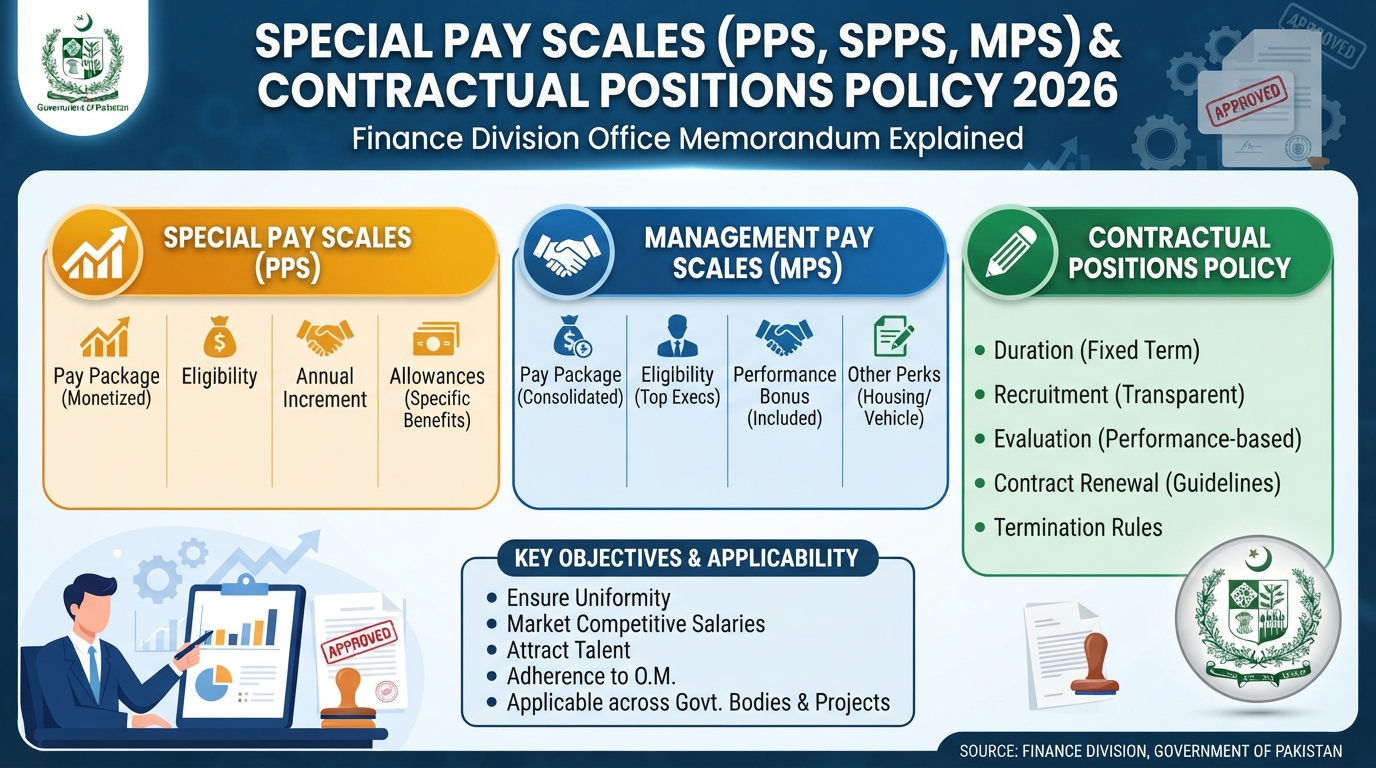
The Finance Division, Government of Pakistan, has issued a new Office Memorandum (O.M.) revising the appointment policy for civil servants against Special Pay Scales — Project Pay Scales (PPS), Special Professional Pay Scales (SPPS), and Management Position Pay Scales (MPS) — while formally bringing Contractual Positions under the same regulatory umbrella. Notification No. F.NO.4(9)R-14/2024-0001, dated 7 September 2026, was issued from Islamabad, marked “Immediate,” and signed by the Section Officer (Regulation-XIV), Finance Division.
For federal civil servants, this notification is directly relevant to appointments in government-owned Corporations, State-Owned Enterprises (SOEs), Autonomous Bodies, and similar organisations — at both the federal and provincial level. Below is a complete, easy-to-follow breakdown of what changed, who it applies to, and what it means for deputation status and career planning.
Show Image
Table of Contents
- Office Memorandum – Quick Facts
- What Are Special Pay Scales? (PPS vs SPPS vs MPS)
- What Does This 2026 Notification Change?
- Appointment Mechanism and Applicability
- Understanding Deputation Status Under This Policy
- Who Does This Policy Apply To?
- Why This Matters for Civil Servants and Government Employees
- Key Terms and Definitions Explained
- Frequently Asked Questions (FAQs)
Office Memorandum – Quick Facts
| Detail | Information |
|---|---|
| Issuing Authority | Finance Division, Government of Pakistan |
| Subject | Appointment of Civil Servants in Special Pay Scales (PPS, SPPS, MPS) / Contractual Position |
| Notification No. | F.NO.4(9)R-14/2024-0001 |
| Date of Issue | 7 September 2026 |
| Place of Issue | Islamabad |
| Amends | Finance Division’s earlier O.M. No.4(9)R-14/2024, dated 1 July 2025 |
| Deputation Reference | Establishment Division’s O.M. No.1/13/87-R-I, dated 3 December 1990 (as amended) |
| Signed By | Zulfiqar Ali Saggo, Section Officer (Regulation-XIV) |
| Addressed To | Zarrar Hasham Khan, Secretary IT, Ministry of Information Technology & Telecommunication |
| Scope of Applicability | Civil servants of the Federal Government of Pakistan joining positions within Federal and Provincial Governments |
What Are Special Pay Scales? (PPS vs SPPS vs MPS)
Before diving into what changed, it helps to understand the three pay-scale categories this policy governs, since each serves a different purpose within Pakistan’s federal government compensation structure:
| Pay Scale | Full Name | Typically Used For |
|---|---|---|
| PPS | Project Pay Scale | Positions created for time-bound development projects, often outside the regular BPS structure |
| SPPS | Special Professional Pay Scale | Technical, specialised, or professional roles requiring market-competitive compensation |
| MPS | Management Position Pay Scale | Senior management and executive-level positions in government-owned corporations, SOEs, and autonomous bodies |
Contractual Positions — the category newly folded into this framework — refer more broadly to any position filled on a fixed-term contract basis rather than through the standard BPS cadre system, typically within the same category of government-owned or government-controlled organisations.
What Does This 2026 Notification Change?
This is a partial modification of the Finance Division’s earlier O.M. No.4(9)R-14/2024, dated 1 July 2025 — the foundational policy already governing MPS, PPS, and SPPS appointments. The 2026 amendment does two specific things:
- Expands scope: Contractual Positions are now explicitly included alongside MPS, PPS, and SPPS under the same policy.
- Substitutes para-3 (i) and (iii): The appointment mechanism and applicability clauses of the original O.M. have been rewritten to reflect this broader coverage.
In practical terms, any civil servant moving into a contractual role in a qualifying organisation is now governed by the same rules that previously applied only to Special Pay Scale appointees.
Appointment Mechanism and Applicability
Revised para-3(i) sets out the core mechanism for how these appointments work:
- A civil servant selected through an open competitive process for a Special Pay Scale or Contractual position in a government-owned Corporation, SOE, Autonomous Body, or similar organisation is permitted to join that appointment.
- The appointment is treated as service on deputation, subject to all conditions of the Establishment Division’s Deputation Policy — O.M. No.1/13/87-R-I, dated 3 December 1990, as amended from time to time — unless the current O.M. states otherwise.
- “Government-owned” covers any entity where government holds a majority stake with management rights — a broad definition that captures most public-sector commercial and semi-autonomous bodies.
- “Government” is defined to include both federal and provincial governments, meaning the policy has nationwide reach, not just federal-level application.
- These terms and conditions apply specifically to civil servants of the Federal Government of Pakistan, whether the position they’re joining sits within the Federal Government or any Provincial Government.
Understanding Deputation Status Under This Policy
One of the most practically important clarifications in this notification is around deputation. When a federal civil servant is selected for a Special Pay Scale or Contractual position through open competition, they don’t resign or transfer out of civil service — they remain on deputation, governed by the long-standing 1990 Establishment Division framework.
This distinction matters because deputation status typically preserves:
- Continuity of pensionable service and seniority within the parent cadre
- The right to revert to the parent department/ministry after the deputation tenure
- Applicability of standard deputation allowances and terms, as amended over time
Civil servants considering a move to an SOE, autonomous body, or provincially-owned corporation should read this O.M. alongside the original 1990 Deputation Policy to understand the full set of applicable conditions.
Who Does This Policy Apply To?
- Federal Government civil servants selected via open competitive process for Special Pay Scale (PPS/SPPS/MPS) or Contractual positions
- Postings within government-owned Corporations, State-Owned Enterprises (SOEs), and Autonomous Bodies
- Positions located in either the Federal Government or any Provincial Government in Pakistan
- Ministries, divisions, and attached departments implementing appointments under this framework — the notification was specifically routed to the Secretary IT, Ministry of Information Technology & Telecommunication, indicating cross-ministry applicability
Why This Matters for Civil Servants and Government Employees
For federal civil servants evaluating opportunities in SOEs, autonomous bodies, or provincially-owned corporations, this notification resolves two practical uncertainties:
- Deputation protection now explicitly covers contractual appointments. Previously, ambiguity existed around whether purely contractual roles (as opposed to formal Special Pay Scale postings) carried the same deputation protections. This O.M. removes that ambiguity.
- A single, unified policy framework. Rather than navigating separate rules for MPS, PPS, SPPS, and contractual hiring, civil servants and HR departments across ministries now work from one consolidated appointment mechanism.
This is especially relevant for officers being headhunted into commercially-run public entities, digital and IT-sector SOEs, and specialised technical bodies where market-based, contract-style compensation is common.
Finance Division notification 2026

Key Terms and Definitions Explained
- Office Memorandum (O.M.): An official government circular used to communicate policy decisions, clarifications, or amendments across ministries and divisions.
- Civil Servant: An employee of the Federal or Provincial Government of Pakistan, appointed under the relevant Civil Servants Act and service rules.
- Deputation: Temporary assignment of a civil servant to a different organisation while retaining lien on their parent department/cadre.
- State-Owned Enterprise (SOE): A commercial entity in which the government holds a majority ownership stake.
- Autonomous Body: A government-created organisation that operates with a degree of administrative and financial independence from a parent ministry.
- Regulation Wing: The wing within the Finance Division responsible for drafting and issuing regulatory policy on civil service pay and appointment matters.
Frequently Asked Questions (FAQs)
Q1: What is covered under this Finance Division O.M.? The appointment of civil servants against Special Pay Scales (Project Pay Scale, Special Professional Pay Scale, Management Position Pay Scale) and Contractual Positions in government-owned Corporations, SOEs, and Autonomous Bodies.
Q2: What is the difference between PPS, SPPS, and MPS? PPS applies to project-based roles, SPPS to specialised professional/technical roles, and MPS to senior management positions in government-owned entities — all three are treated as “Special Pay Scales” distinct from the regular BPS structure.
Q3: Does this policy apply to provincial government employees? The rules apply to civil servants of the Federal Government of Pakistan, but they can take up qualifying positions within both Federal and Provincial Governments.
Q4: What happens to a civil servant’s employment status after joining such a position? They are treated as being on deputation, under the conditions of the Establishment Division’s Deputation Policy (O.M. No.1/13/87-R-I, dated 3 December 1990, as amended).
Q5: What does “government-owned” mean under this policy? Any entity in which the government (federal or provincial) holds a majority stake with management rights.
Q6: Is this a completely new policy or an amendment? It is a partial modification of the existing Finance Division O.M. No.4(9)R-14/2024, dated 1 July 2025 — specifically updating para-3 (i) and (iii) to add Contractual Positions.
Q7: Where can civil servants verify the original notifications? Directly on the Finance Division’s official website for the 2026 and 2025 O.Ms, and the Establishment Division’s official website for the referenced 1990 Deputation Policy.
Related Government Employee Resources
For more updates on federal pay policy, allowances, and civil service notifications, check our Pay Scale 2026-27: BPS 1–22 Revised Basic Pay Chart & Salary Calculator, which tracks the latest Finance Division circulars affecting government employees. Browse Government Jobs in Pakistan Today for the newest federal and provincial vacancy announcements, including postings in autonomous bodies and SOEs that this policy directly affects.
If you’re a civil servant preparing to apply for a Special Pay Scale or contractual position, confirm eligibility windows with our free Age Calculator, and build an updated CV with our free Resume Builder before applying.
Disclaimer: NewPakistanJobs.com is an independent job and career information portal. We are not affiliated with the Finance Division, Establishment Division, or the Government of Pakistan. This article is based on the Office Memorandum dated 7 September 2026 and is shared for informational purposes. Always verify current policy details from the official Finance Division website before making any employment decision.